Formats 16

Wingo, Lottery Rounds and the Other Timed Formats

Play colour rounds

Colour rounds sit inside a family of timed draws that share one engine and differ mostly in presentation. Knowing which parts change and which do not saves a great deal of comparison.

1generated number
Manynames for it
Samestructure underneath
The family

Three Formats You Will Meet

All of them resolve a generated value on a fixed timer. The differences are in what you are asked to bet on.

Colour rounds Colour rounds

A digit, a colour, a size

The format this site is about. One digit settles colour, size and exact-number markets simultaneously.

Wingo-style rounds Wingo-style rounds

The same idea, branded

A timed draw with colour and size markets under a different name. Where the operator is the same, so is the engine.

Timed lottery draws Timed lottery draws

A number from a wider range

More possible outcomes and correspondingly larger multipliers. The coverage-against-payout rule works exactly as it does elsewhere.

The rule that travels

Coverage multiplied by payout comes to a little under one, in every format in this family. That is what makes them all the same game underneath, whatever the interface shows.

It is also why moving between formats to find better value is an exercise with no destination.

Coverage

The Same Arithmetic Across Formats

Blocks are the share of outcomes each bet covers, scaled to ten.

Colour, main shadeAbout half the outcomes
≈1.95x
Big or smallExactly half
≈1.95x
Exact digitOne in ten
≈9x
Wide-range lottery pickOne in many
much higher
What actually differs

Four Things Worth Checking

None of them is the odds, which are near-identical once coverage is accounted for.

Timer length

Thirty seconds to five minutes. This is the setting that decides what an hour costs.

Cost

Minimum stake

Varies by operator and by table, and it interacts with the session plan rather than the odds.

Plan

Number of markets

Some formats add side bets. More buttons, same underlying draw.

Cosmetic

Result presentation

Wheels, cards, balls or plain digits. Entirely a rendering of a value already produced.

Cosmetic
Practical

Four Things That Transfer Between Formats

Everything on this site applies across the family, which is why we do not write a separate guide for each name.

The turnover calculation. Stake times rounds times the edge. It works in every format and it is the only figure that changes by a factor.

The independence of rounds. No format in this family carries information from one draw to the next, whatever the history strip shows.

The stopping rule. A round count decided in advance holds identically on a colour board and a lottery draw.

The prediction answer. The value is produced after betting closes in all of them, which is why no tool works in any of them.

Why the Names Multiply

Because a format is cheap to re-skin and a name is cheap to register. An operator adding a timed draw to its lobby gets a new product page, a new search term and a new set of screenshots without changing anything about the engine. From a player's point of view the result is a menu that looks varied and behaves identically.

It also means guides written for one name usually apply to the others, which is worth knowing before paying for advice about a specific format.

The One Genuine Difference

Range. A draw with a hundred possible outcomes pays far more and lands far less often than one with ten, and the swings are correspondingly wider. That changes how a bankroll behaves and how a session feels, without changing the expected cost per rupee staked.

How coverage and payout interact is set out on the coverage page, and every guide is listed on the home page.
FAQ

Is Wingo the same as colour trading?

+

In most lobbies it is the same style of timed draw with colour and size markets under a different name. Where the operator is the same, the engine usually is too.

Do lottery rounds have better odds?

+

They have wider ranges and bigger multipliers, priced against how rarely they land. The share retained works out similarly once coverage is accounted for.

Which format should I play?

+

Whichever suits the session shape you want. The expected cost per rupee is close across the family; the variance is not.

Do the same prediction tools work on all of them?

+

They fail identically everywhere, because in every format the value is produced after betting closes on the operator's servers.

Does the result animation mean anything?

+

No. Wheels, balls and cards are renderings of a value that already exists by the time the animation starts.

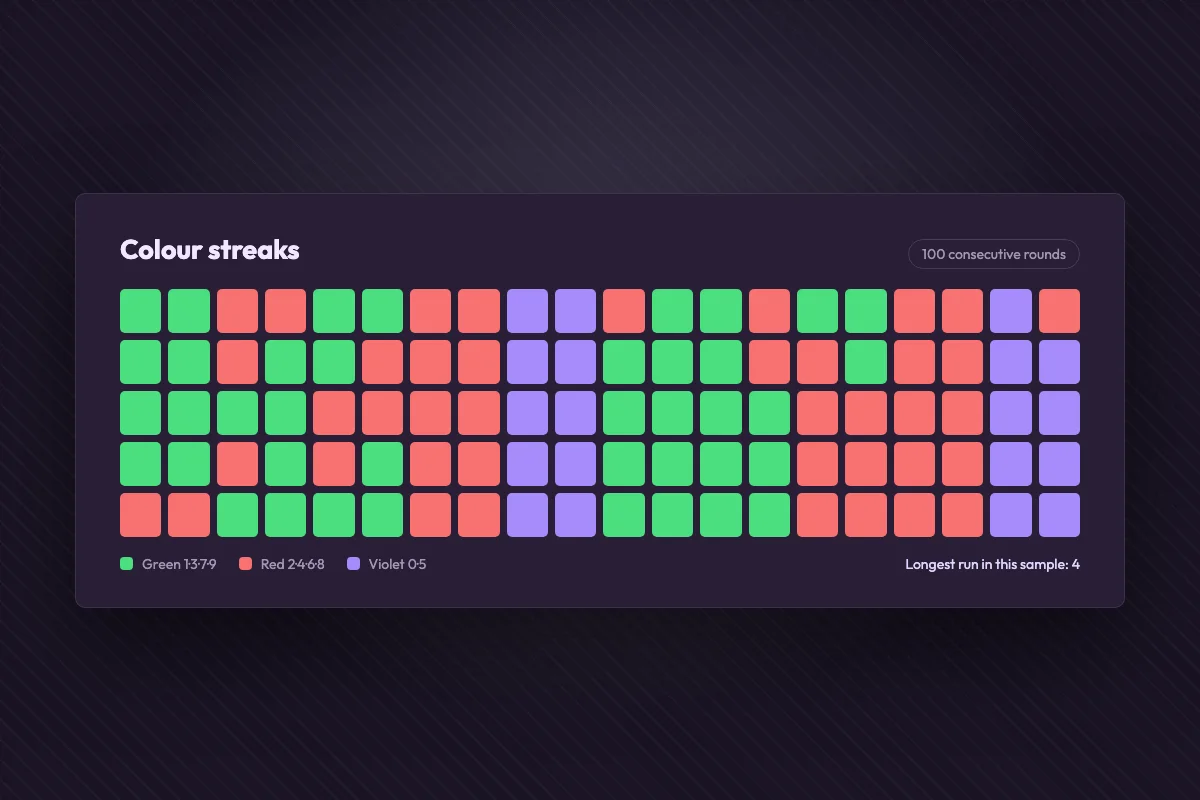
Grid of sixty consecutive results coloured green, red and violet showing how long a colour run can last

This website is for informational purposes only and is not a gambling operator: we do not accept bets or payments. 18+. Gambling involves risk and may lead to addiction — please gamble responsibly. Information (bonuses/terms/licenses) may change: check current rules on the operator’s website. We are not responsible for decisions and financial losses related to the use of third-party services.