Intuition 07

Streaks, Due Colours and the Gambler's Fallacy

Play colour rounds

Seven reds in a row does not feel like nothing. It feels like a fact about the table, and the feeling is strong enough that most people act on it without deciding to.

50%the next round, always
2opposite mistakes
Stakewhere it actually costs
How long runs get

Longer Than the Intuition Allows

Rough figures for an even-money outcome over a hundred rounds. They surprise almost everybody the first time.

At least one run of fiveEffectively certain
~97%
At least one run of sevenExpected in most sessions
~55%
At least one run of tenUncommon, not remarkable
~9%
Next round continues the runWhatever the run's length
50%
Two mistakes

The Same Screen, Opposite Conclusions

Both readings are confident and both are wrong, and the fact that they contradict each other is the clearest evidence that the screen contains nothing.

Mistake Mistake

The correction is due

Six reds, so green must be coming. The generator holds no record of the six and owes nothing to either side.

Mistake Mistake

The run is hot

Six reds, so red is running. Identical data, opposite conclusion, same fifty per cent.

Consequence Consequence

The stake rises

Both readings feel like information, and information invites a larger bet. That is where a streak stops being harmless.

Why the intuition is so strong

Asked to write a hundred imaginary coin flips, almost everybody produces too few long runs. Real sequences are lumpier than invented ones, so a genuine streak looks abnormal precisely because it is genuine.

It is also why fabricated histories are easy to spot statistically: they alternate far too much.

How the money leaves

The Sequence That Actually Costs

Not the losing calls — a random choice loses at the same rate. What costs money is what a streak does to stake size.

A streak appears

The next call feels more certain than the last one.

Step 1

The stake rises

Often two or three times the usual size, to match the certainty.

Step 2

The call is still a coin flip

So it fails about half the time — now at the larger stake.

Step 3

The loss reinforces the theory

Read as the run continuing, which strengthens the conviction rather than weakening it.

Step 4
Practical

Four Things Worth Holding On To

None of them is a system. They are corrections to a reading the interface encourages.

A streak is a record, not a signal. Six reds happened. That is the complete content of the strip, and it would look the same either way.

Nothing is due. The generator has no memory and no obligation to any outcome. Balance comes from swamping, not correcting.

Watch your own streak instead. A run of losses does not change the next round, but it does change what you are likely to do — and that is a real dependency.

Keep the stake flat through runs. This single rule removes almost all of the cost that streak-reading produces.

Where the Fallacy Meets the Market

Most prediction products in this category are built on it. Due-colour logic, streak detectors and dragon alerts convert this intuition into an interface, which is why they feel immediately right — the product is agreeing with something you already believed before you opened it.

That agreement is the entire product experience. It does not require the calls to be correct, only for them to arrive at moments when the screen already looks meaningful.

The One Streak With Real Predictive Value

Your own. Rising stakes after losses is the most reliable predictor of how an evening ends, and it is visible in a session log long before it is visible in a balance. Unlike the digits, that pattern is genuinely connected to what happens next.

How to keep that log is on the record-keeping page, and every guide is listed on the home page.
FAQ

After six reds, is green more likely?

+

No. Each round is generated independently, so the probability is the same it was before the run started. The six rounds leave no trace in the system.

How long can a streak realistically go?

+

Runs of seven appear in about half of all hundred-round sessions, and runs of ten are not rare across a week of play.

Is following a streak better than betting against it?

+

Neither is better; both are fifty per cent. They are exact opposites with identical long-run results, which is the clearest sign the streak carries no information.

Do streak alerts in apps help?

+

They tell you accurately what already happened. The alert adds urgency to a moment that contains no more information than any other, and urgency raises stakes.

Why does the fallacy feel so convincing?

+

Because people expect random sequences to look evenly mixed. Real ones are lumpier, so a genuine streak registers as something demanding explanation.

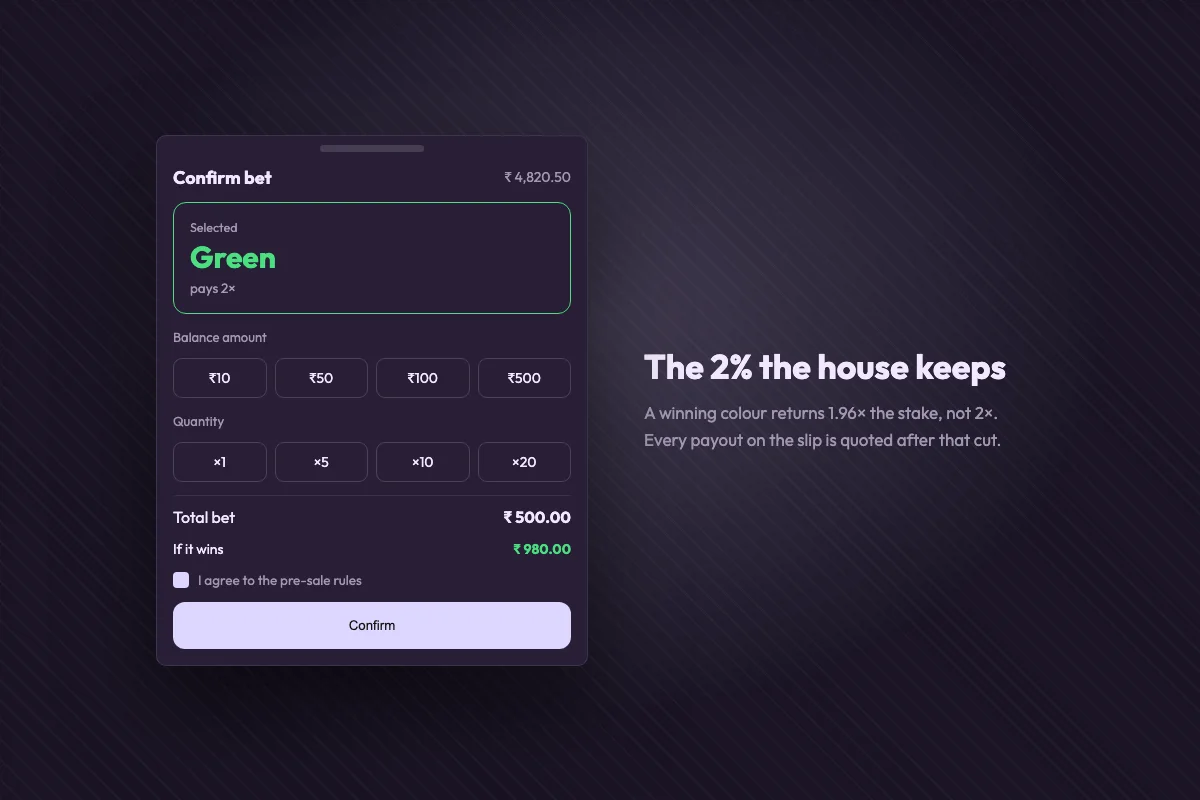
Bet confirmation screen with Green selected, stake and quantity chips and the payout left after the two per cent fee

This website is for informational purposes only and is not a gambling operator: we do not accept bets or payments. 18+. Gambling involves risk and may lead to addiction — please gamble responsibly. Information (bonuses/terms/licenses) may change: check current rules on the operator’s website. We are not responsible for decisions and financial losses related to the use of third-party services.