Practical 12

What a Losing Run Actually Looks Like

Play colour rounds

Most players' picture of a bad sequence is milder than the real thing, which is why a genuine one feels like something has gone wrong. Usually nothing has, and knowing the shape in advance is most of the defence.

7losses in a row is ordinary
50%the next round, still
2decisions to make early
The shape

How Bad an Ordinary Run Gets

Approximate chance of seeing at least one run of that length across a hundred even-money rounds.

Five losses in a rowExpect it most sessions
~97%
Seven in a rowMore often than not
~55%
Ten in a rowUncommon, not evidence of anything
~9%
Recovery being due afterwardsNo mechanism exists for it
0%
What a bad run is not

It is not the app turning against you, not a sign that the operator noticed your stake, and not a signal that a correction is close. It is the ordinary lumpiness of independent results, arriving in one evening.

The generator produced each of those digits without reference to the ones before it, which is exactly why long runs happen at all.

What it does

Three Effects Worth Naming

None of them is on the board. All three are in the player.

Effect Effect

Stake size rises

The most reliable consequence and the most expensive. Certainty and frustration both push in the same direction.

Effect Effect

Market switching

From an even-money bet to the high-multiplier grid, because recovery in one round starts to look necessary.

Effect Effect

Session extension

The plan quietly becomes playing until level, which is a session with no end condition attached to it.

In the moment

Four Responses, Ranked

The first two are decisions; the last two are what usually happens instead.

Stop at the round count

The plan made while calm, executed while not. This is the entire skill available here.

Best

Continue at the same stake

Costs no more than the plan already allowed, and keeps the evening's shape intact.

Fine

Raise the stake

Increases turnover at the exact moment it was least intended. The most common route to a memorable loss.

Costly

Switch to the number grid

Cuts coverage from half to a tenth while the stake is usually largest.

Worst
Before it happens

Four Things to Decide in Advance

All four are easier to set on a quiet evening than during a run.

The round count. Written down before the session and not revisited during it. A run does not change how many rounds you agreed to play.

The flat stake. One number for the whole session, whatever the last ten rounds did.

What you will not do. Naming the two moves above in advance makes them recognisable when they present themselves as reasonable.

Where the session ends. A specific point rather than a feeling. Being level is not a stopping condition, because it may never arrive.

Why the Shape Is Worth Knowing

Because a run of seven feels like evidence, and evidence invites action. If you already know that seven in a row happens in more than half of hundred-round sessions, the same run reads as ordinary — and ordinary events do not demand a response. That single reframing prevents most of what a losing run actually costs.

It also removes the two stories people tell afterwards: that the app was rigged, or that they were unlucky in some meaningful sense. Both treat a normal sequence as an anomaly.

The One Thing That Genuinely Helps

A session length decided in rounds, before the app opens. It is the only mechanism that behaves identically whether the evening is going well or badly, which is precisely what a rule has to do to be worth having.

How to set one that holds is on the session limits page, and every guide is listed on the home page.
FAQ

Is a long losing streak a sign the app is rigged?

+

No. Runs of seven appear in most hundred-round sessions purely from independent results, and a licensed operator earns its share without any interference.

Should I increase my stake to recover?

+

It increases turnover at the moment it was least intended, which raises the expected cost. Recovery is not available at these odds.

Is a colour due after a long run?

+

No. Each round is generated independently, and the generator keeps no record of what it produced before.

How long can a bad run last?

+

Longer than intuition suggests. Ten in a row is uncommon rather than remarkable across a week of play.

What is the best thing to do during one?

+

Stop at the round count you set in advance, or continue at the same stake. Both are decisions; raising the stake is a reaction.

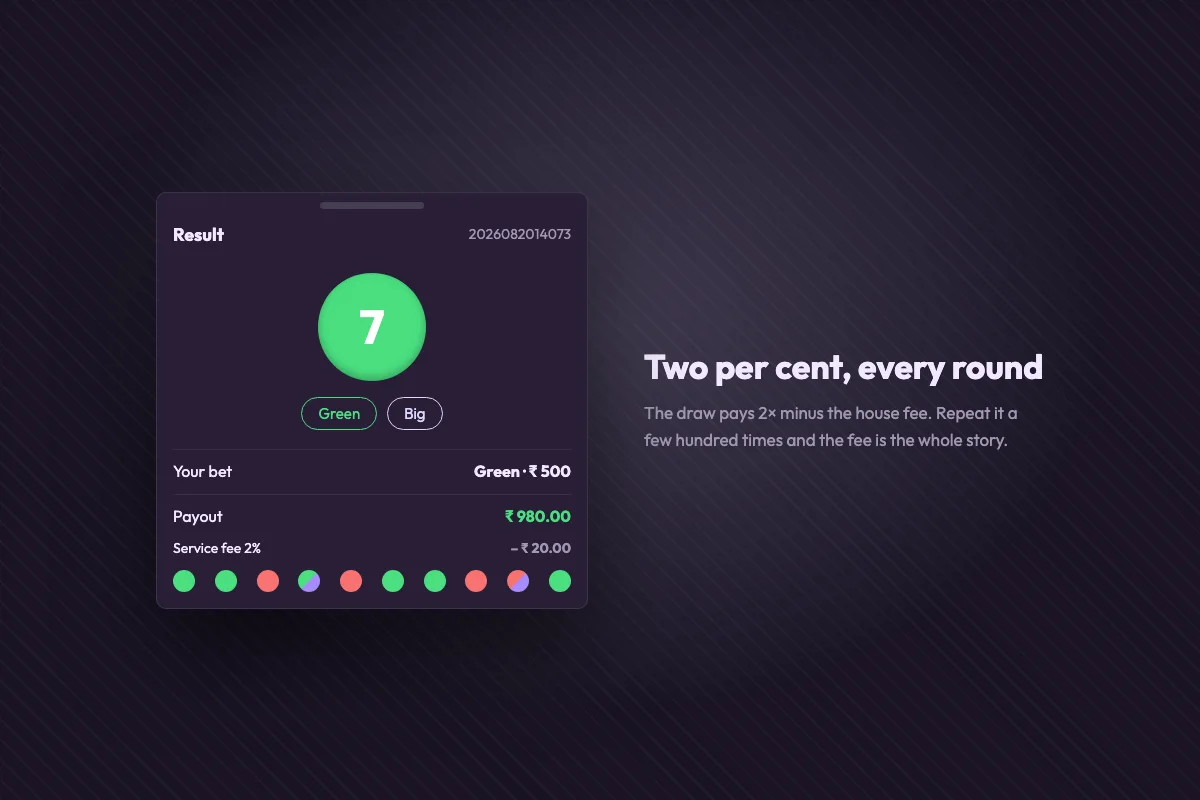
Result screen showing the drawn number seven tagged Green and Big, with the payout and the two per cent fee

This website is for informational purposes only and is not a gambling operator: we do not accept bets or payments. 18+. Gambling involves risk and may lead to addiction — please gamble responsibly. Information (bonuses/terms/licenses) may change: check current rules on the operator’s website. We are not responsible for decisions and financial losses related to the use of third-party services.