Money 03

House Edge, Turnover and What an Hour Costs

Play colour rounds

Two numbers explain more about this game than every strategy guide combined: the share of turnover the operator keeps, and how much turnover an hour of rounds produces. Both are knowable before you play.

~3%typical house edge
Turnoverwhat it is charged on
60–120rounds in an hour
The basics

What the Published Figure Describes

A return-to-player percentage is a long-run property of the game, not a promise about your evening.

Long run Long run

A share of turnover

At 97%, about three rupees in every hundred staked stays with the operator across a very large number of rounds.

Not a deposit Not a deposit

Turnover is not the same thing

A ₹1,000 deposit played through twenty times is ₹20,000 of turnover, and the edge applies to all of it.

Not due Not due

There is no correction

The generator keeps no record of how far recent results sit from the average and does not steer back toward it.

The arithmetic

What an Hour Costs at Each Stake

Assuming one-minute rounds, which is sixty rounds an hour. Halve everything for two-minute play, double it for thirty seconds.

₹10 a round

₹600 of turnover in the hour.

≈₹18

₹20 a round

₹1,200 of turnover in the hour.

≈₹36

₹50 a round

₹3,000 of turnover in the hour.

≈₹90

₹200 a round

₹12,000 of turnover in the hour.

≈₹360

₹50 on a 30-second table

₹6,000 of turnover in the same hour.

≈₹180
The distinction that costs most

Deposits are what you notice. Turnover is what you are charged on, and it is usually many times larger than anything you deposited.

A player who tracks turnover for one session usually revises how they play within a week, without being told anything else.

What moves it

Three Ways to Change That Number

None involves winning more often. All three are decisions available before the first round.

Stake sizeHalve it and halve the cost
linear
Rounds per hourA slower table cuts it directly
linear
Session lengthThe multiplier on both of the above
linear
Market choiceChanges variance, not the share
≈none
Confusions

Four Figures People Mix Up

All four appear in guides and all four describe different things.

Return to player. A long-run share of turnover returned, published by the studio and usually visible in the game's information panel.

House edge. The complement — around three per cent here. This is the number to multiply turnover by when estimating what an evening costs.

Hit rate. How often a chosen market lands. It varies enormously by market and says nothing about expected cost on its own.

Maximum multiplier. A ceiling on one round rather than a statement about returns. A board with a 9x top and one with 100x can share an identical edge.

Why Three Per Cent Adds Up

Per round it is negligible, which is exactly the design. What makes a session cost what it does is that the same share is charged again on every round, and rounds arrive quickly. Sixty of them an hour turns a small per-round share into a predictable hourly figure, which is why turnover rather than the edge is the number worth tracking.

It is also why no market choice and no stopping rule rescues a long session. Those change the shape of the results; the hourly cost is set by how much money passes through the board.

The Honest Version of a Plan

Decide what an evening of this is worth to you as entertainment, divide by the edge to get the turnover it supports, then divide by rounds per hour to get a stake. It takes a minute and it is the only calculation here that reliably does what it says.

The stake side of that calculation is worked through on the stake and bankroll page, and every guide is on the home page.
FAQ

What is the RTP of colour trading rounds?

+

Commonly around 97%, though it varies by operator and is usually shown in the game's information panel. The remaining share is the house edge.

Does the house edge change between markets?

+

Barely. Payouts are priced against coverage, so the share retained is similar whether you bet colour, size or an exact number.

Can I calculate what a session will cost?

+

In expectation, yes: stake times rounds played times about three per cent. Real results swing widely around that, but it is the right number to plan with.

Why do my results look nothing like 97%?

+

Because a few hundred rounds is a small sample. The figure describes an average across a very large number of rounds, not any single evening.

Is a slower table cheaper?

+

At the same stake, yes — fewer rounds per hour means less turnover, and turnover is what the edge is charged on.

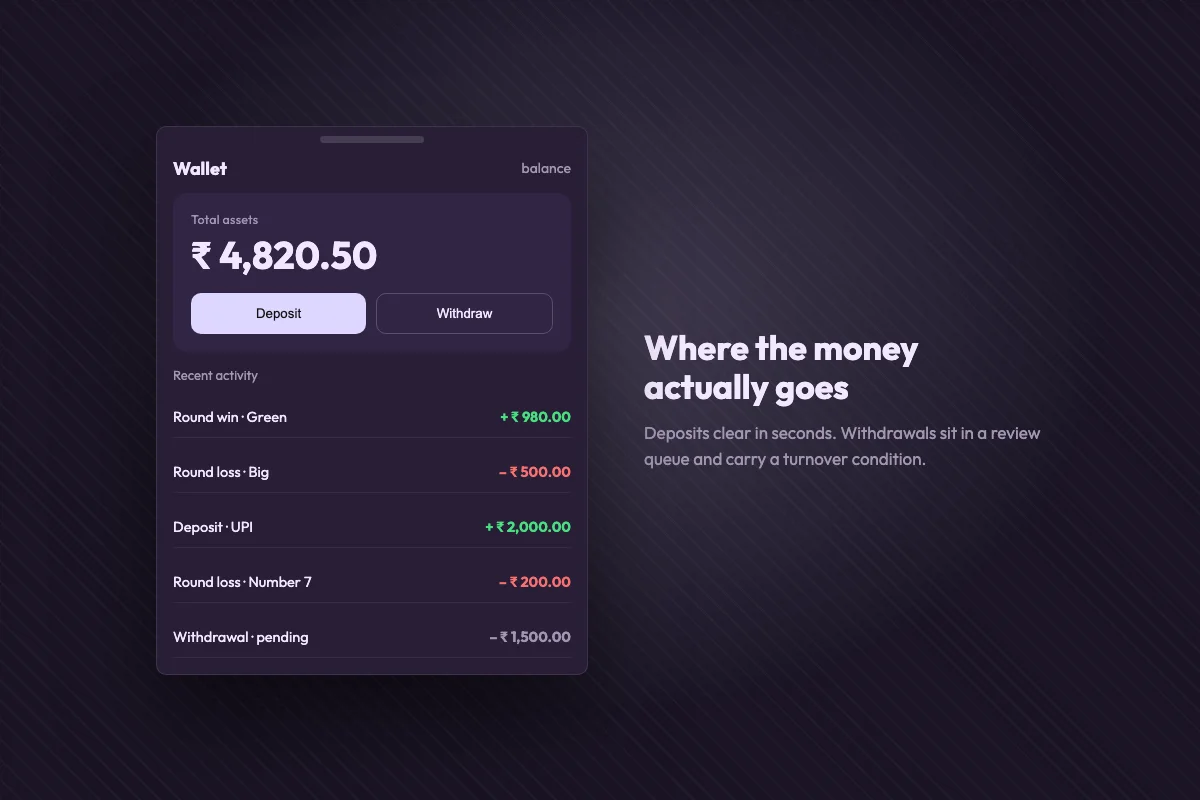
Wallet screen showing the balance, deposit and withdraw buttons and a list of recent round wins and losses

This website is for informational purposes only and is not a gambling operator: we do not accept bets or payments. 18+. Gambling involves risk and may lead to addiction — please gamble responsibly. Information (bonuses/terms/licenses) may change: check current rules on the operator’s website. We are not responsible for decisions and financial losses related to the use of third-party services.