Money 13

Deposits, UPI and Paying Into a Colour App

Play colour rounds

Money moving in is designed to be effortless, and mostly it is. The differences between routes only become visible when something goes wrong, which is the wrong time to discover them.

Instantevery route
1check that matters most
0recourse on personal transfers
The routes

Four Ways In, Compared

The methods themselves are ordinary. What differs is what happens when a payment is disputed.

UPI to a business account

The standard route in India and generally fine when the payee is a registered company.

Ordinary

Card

Slowest to withdraw back to, and the strongest position in a dispute.

Reversible

Wallet

Convenient. Check that the same wallet supports withdrawals before using it for deposits.

Check first

UPI to a personal account

No licensed operator collects this way, and money sent to an individual is effectively unrecoverable.

Avoid
The one check

Look at who the payee is before confirming. A registered business name is ordinary; an individual's name is the single clearest warning available in this market.

It takes two seconds, it happens on every deposit, and it eliminates most of the genuinely unrecoverable outcomes people describe.

Before the first deposit

Three Things Worth Confirming

All three are on the operator's own pages and none takes more than a minute.

Check Check

The minimum withdrawal

Sometimes higher than the minimum deposit, which can strand a small balance until you top it up.

Check Check

Whether the same method pays out

Return-to-source rules mean you will usually be paid back the way you paid in. A one-way method causes problems later.

Check Check

Fees and processing windows

Both are usually stated in the banking terms, and knowing them turns an eight-hour wait into an expected one.

Habits

Four That Cost Nothing

Each removes a specific failure mode we hear about repeatedly.

Deposit the minimum that supports the session. Not a round number, and not extra for convenience. Adding funds later should be a deliberate act.

Never use somebody else's method. It breaks the return-to-source rule and is the most reliable way to make a withdrawal impossible.

Do not save the payment method. Friction at the second deposit is the moment friction is most useful.

Keep the transaction reference. For every deposit. A dispute succeeds on documentation rather than on argument.

If a deposit goes wrong

Four Steps, in Order

Speed matters more than anything else here, particularly on transfers to individuals.

Immediately

Stop adding funds

Whatever the support chat suggests. A request for a further deposit to release a balance has no legitimate version.

Same day

Collect the records

Transaction reference, timestamp, screenshots of the deposit screen and any chat with support.

Same day

Contact the payment provider

Bank or wallet, particularly if the payee was an individual. The window for recovery is short and closes quietly.

Afterwards

Write it down

What happened and when. If it becomes a longer process, a contemporaneous record is worth more than memory.

Why Deposits Feel Different From Withdrawals

Because they are different processes with different obligations. Taking money is a payment; releasing it is a regulated transfer that requires the operator to know who they are paying. That asymmetry is not evidence of bad faith, and it is why an instant deposit and a two-day withdrawal can both be entirely normal.

It does mean the friction is all on one side, and that the moment when you most want speed is the moment there is least of it. Testing the exit early is the only way to know what that will feel like.

The Rule Worth Keeping

Never deposit through a method you cannot withdraw to. It sounds obvious and it is behind a large share of the stuck-balance stories in this category, usually via a friend's account or a wallet that only supports payments in one direction.

What the withdrawal side involves is on the withdrawals page, and every guide is listed on the home page.
FAQ

Is UPI safe for depositing into these apps?

+

To a registered business account, generally yes. To a personal account it is effectively unrecoverable, and no licensed operator collects deposits that way.

Why does the app ask me to pay an individual?

+

There is no legitimate reason. It is the clearest single warning sign in this market and a good point at which to stop.

Can I deposit from a friend's account?

+

It breaks return-to-source rules and is the most common cause of a withdrawal that cannot be completed. Use your own method only.

Should I save my payment details in the app?

+

It is convenient and removes friction from a second deposit, which is exactly the moment friction is useful. We would leave it out.

What should I do if a deposit does not arrive?

+

Keep the transaction reference, contact support in writing, and involve your bank the same day if the payee was an individual rather than a business.

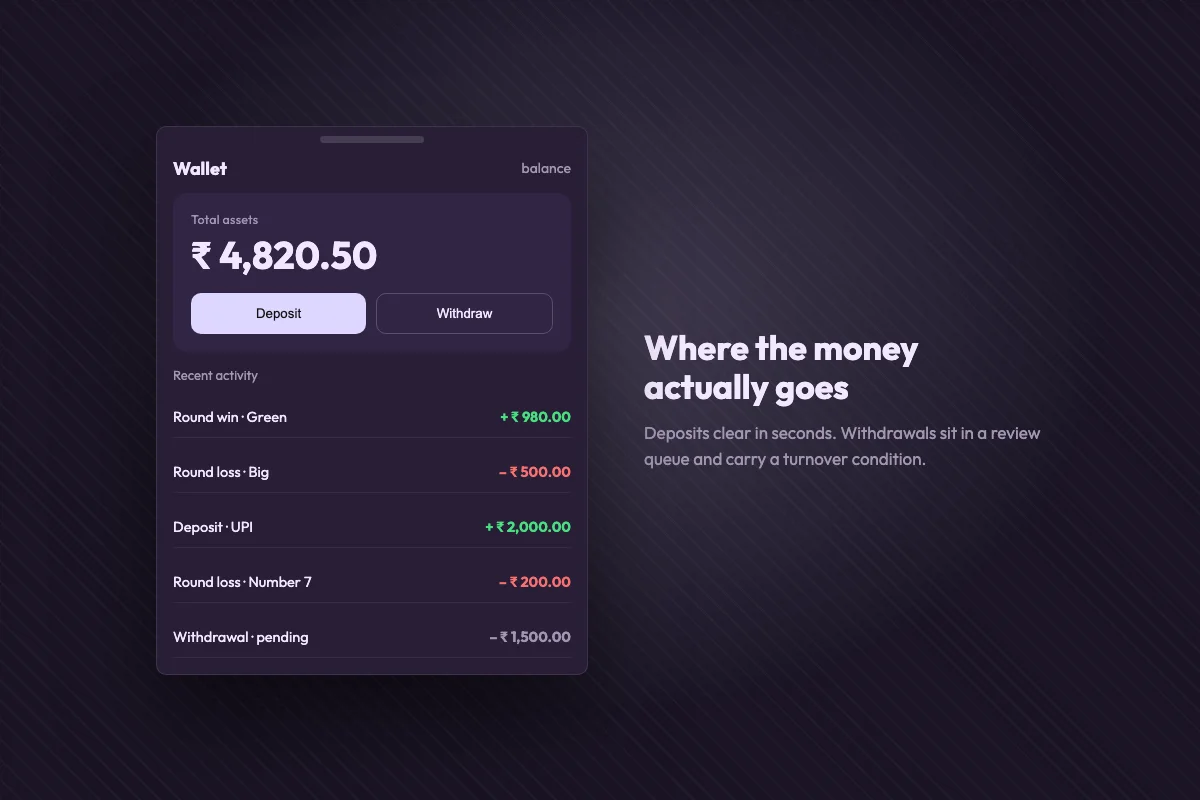
Wallet screen showing the balance, deposit and withdraw buttons and a list of recent round wins and losses

This website is for informational purposes only and is not a gambling operator: we do not accept bets or payments. 18+. Gambling involves risk and may lead to addiction — please gamble responsibly. Information (bonuses/terms/licenses) may change: check current rules on the operator’s website. We are not responsible for decisions and financial losses related to the use of third-party services.