Settings 05

Choosing a Timer: Thirty Seconds to Five Minutes

Play colour rounds

The timer looks like a preference and behaves like the most consequential setting on the screen. It does not touch the odds of a single round and it changes what an hour costs by a factor of ten.

Sameodds per round
10xdifference per hour
1setting worth thinking about
Rounds per hour

What Each Table Actually Produces

Blocks are relative volume. Same stake, same odds, very different totals.

Five-minute table12 rounds an hour
₹600
Three-minute table20 rounds an hour
₹1,000
One-minute table60 rounds an hour
₹3,000
Thirty-second table120 rounds an hour
₹6,000
What changes

Two Columns, One Difference

Everything about a single round is identical across timers. Everything about an hour is not.

Identical Identical

Chance and payout

A colour bet is the same bet at thirty seconds and at five minutes. The generator does not know which table it is producing a digit for.

Different Different

Rounds per hour

Twelve against a hundred and twenty. A tenfold difference in how often the operator's share is applied to your money.

Different Different

Time to decide

Five minutes leaves room to stop. Thirty seconds leaves room to do nothing except keep going, which is a design outcome rather than a side effect.

Why speed is the lever

Every figure that matters is multiplied by rounds per hour. Nothing else in the interface has that property, which is why the timer is the only control worth thinking hard about.

It is also the one setting presented with no explanation, usually defaulting to the fastest and busiest table.

Why tools cluster on fast tables

Four Reasons

There is a reason almost every predictor and signal room operates on the shortest timer available.

Results arrive quickly

A tool making a call every thirty seconds shows a win within minutes of installation.

Speed

Volume hides the record

At a hundred and twenty rounds an hour nobody keeps a count, so the tool is judged on impression.

Volume

Recovery feels immediate

A loss is followed by another chance almost at once, which removes the pause where somebody might stop.

Pace

Affiliate revenue follows turnover

A channel paid a share of what members stake earns ten times as much from a fast table.

Incentive
Choosing

Four Practical Points

None improves your odds. All four change what an hour costs.

Pick the slowest table you will actually use. It does not improve a round; it reduces turnover per hour, which is the number that decides the cost.

Set the session limit in rounds. A hundred rounds means the same thing on any table. An hour means ten different things depending on the timer.

Do not raise the stake to compensate. Raising the stake because there are fewer rounds reverses the entire benefit.

Treat a fast-only room as a statement. A room that offers nothing but thirty-second rounds is telling you what it is optimised for.

The Setting Nobody Reads as a Setting

Speed feels like a matter of taste, and it is presented that way — a small toggle, no warning, no explanation, with the fastest option usually the default. Nothing about the interface suggests that the choice multiplies the cost of an evening by ten, and there is no reason for the interface to mention it.

It is also the clearest example of something genuinely under your control in a game where the widely marketed controls are not. You cannot influence a digit. You can decide how many digits your money passes through in an hour.

The Comparison Worth Running

Play a hundred rounds on a five-minute table and a hundred on a thirty-second one, at the same stake, then compare what each session cost and how long it took. The odds were identical; the experience and the total staked were not. It is the only experiment here that reliably changes behaviour afterwards.

The arithmetic behind those totals is on the house edge page, and every guide is listed on the home page.
FAQ

Are fast rounds rigged differently?

+

No. Generation is identical across timers — the only difference is how many times per hour the same odds and the same share are applied to your stake.

Which timer is best for a player?

+

The slowest one you will actually use. It does not improve any single round; it reduces turnover per hour, which is what decides the cost.

Why do prediction tools prefer 30-second tables?

+

Because they demonstrate quickly and the volume makes a record impossible to keep in your head. Both help the impression rather than the accuracy.

Does a longer timer give more time to analyse?

+

It gives more time, and there is nothing in the history to analyse. What the extra minutes genuinely provide is room to decide whether to keep playing.

Is playing fewer, larger bets better?

+

It changes variance rather than expected cost. Turnover is what matters, and raising the stake to compensate for fewer rounds simply restores it.

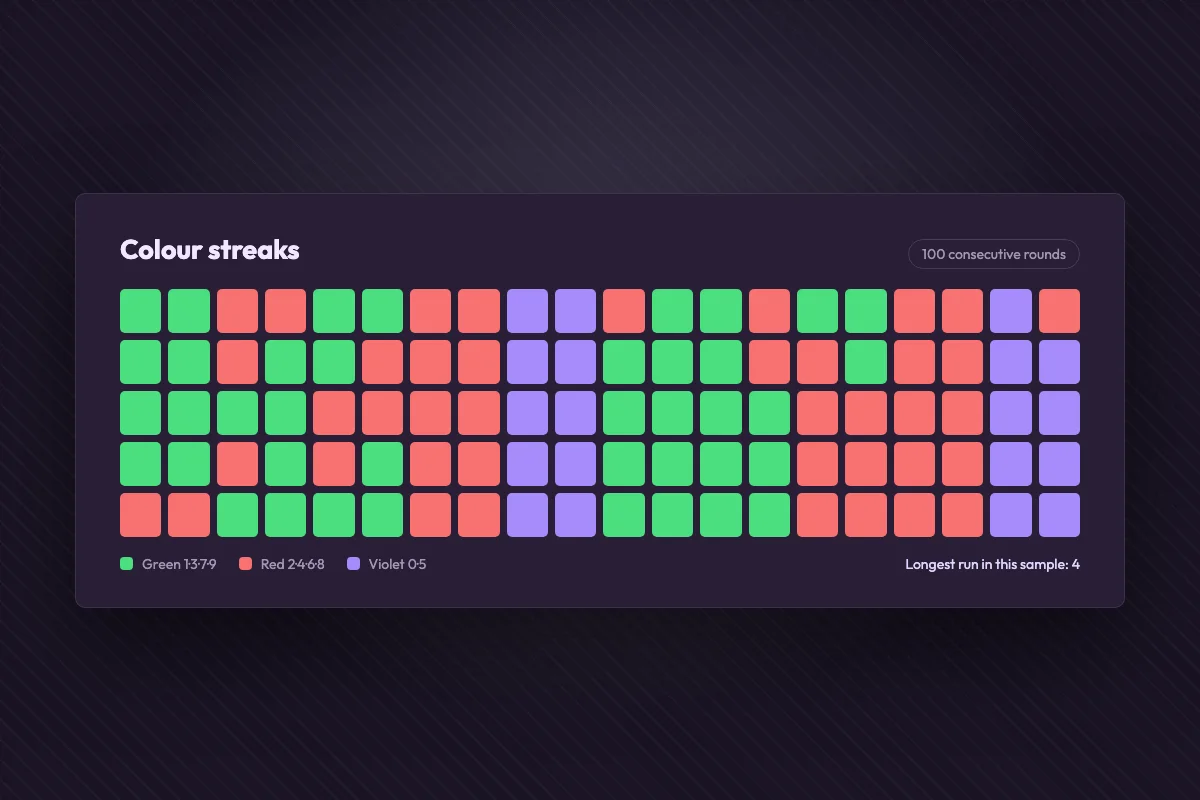
Grid of sixty consecutive results coloured green, red and violet showing how long a colour run can last

This website is for informational purposes only and is not a gambling operator: we do not accept bets or payments. 18+. Gambling involves risk and may lead to addiction — please gamble responsibly. Information (bonuses/terms/licenses) may change: check current rules on the operator’s website. We are not responsible for decisions and financial losses related to the use of third-party services.