Money 04

Stake Size, Bankroll and the Number Nobody Tracks

Play colour rounds

Ask a player what they lost last night and you get a balance figure. Ask what they staked in total and you usually get a pause. Turnover only moves in one direction, and it is entirely under your control.

Stake × rounds= turnover
Flatthe only pattern worth keeping
Roundshow to count a session
Setting it

Choose the Stake From the Cost, Not the Feel

Most players pick a stake that seems reasonable and discover the cost afterwards. Reversing that takes a minute.

Step 1

Decide the hourly figure

What is an evening of this worth to you as entertainment? Pick a number in rupees before opening anything.

Step 2

Divide by the edge

Around three per cent. An acceptable cost of ₹100 an hour supports roughly ₹3,300 of turnover in that hour.

Step 3

Divide by rounds per hour

At sixty rounds, ₹3,300 of turnover means a stake around ₹55. A slower table supports a larger stake for the same cost.

Step 4

Fix the session length

In rounds. The stake and the round count together produce the figure you started from, and both are decided before the first press.

The pattern to watch for

Raising the stake after losses is not a strategy. It is a rate increase applied at the worst possible moment, and it is the most common route from an ordinary evening to a memorable one.

It is also the behaviour every recovery system formalises and every prediction tool implicitly encourages, by making the next round feel more certain than the last.

Bankroll

How Long the Same Money Lasts

Blocks are rounds survived out of ten on an average run, illustrative rather than exact — the point is the ordering.

₹20 flat, even-money marketSmall steps, long sessions
steady
₹50 flat, even-money marketSame shape, faster burn
steady
₹50 on the number gridLong flat stretches, rare jumps
spiky
Doubling after lossesComfortable until it is not
cliff
Progressions

What a Doubling Ladder Actually Reaches

Starting at ₹20 and doubling after each loss. Nothing unusual has happened by the bottom row.

First loss

Stake doubles. Recovery needs one win, which is why it feels controlled.

₹40

Third loss

Still comfortable, and most sessions never go past here.

₹160

Fifth loss

Sixteen times the opening stake, chasing the original ₹20.

₹320

Seventh loss

Sixty-four times the opening stake. Seven losses in a row is an ordinary event.

₹1,280
Practical

Four Rules That Hold Under Pressure

Boring, and they work better than resolutions made mid-session.

One stake for the whole session. The same amount every round, whatever just happened. This is the entire content of sound bankroll management here.

Count rounds, not minutes. Minutes stretch to fit whatever is happening. A round count does not, and it maps directly onto turnover.

Set an account-level deposit limit. Where the operator offers one it is worth more than any private resolution, because it cannot be overridden at midnight.

Remove saved payment methods. A second deposit should require deliberate effort. Friction at that moment is the cheapest protection available.

A Worked Example

Somebody comfortable spending about ₹150 on an evening has roughly ₹5,000 of turnover to work with. At sixty rounds an hour that is a stake of around ₹80 for one hour, or ₹40 for two. Both plans cost the same in expectation; the second lasts twice as long and swings half as hard, which is why most people prefer it once they have seen the arithmetic.

Note what is absent from that calculation: any assumption about winning. Expected cost is the price of the entertainment, and results move around it in both directions.

The Simplest Version

Pick a stake, keep it identical all evening, and decide in advance how many rounds you will play. Everything else in bankroll management is refinement on top of those two decisions, and almost every expensive session in this category is a story about breaking one of them.

How the timer multiplies all of it is on the timer page, and every guide is listed on the home page.
FAQ

What is a sensible stake for colour trading?

+

Work backwards from what you are willing to spend per hour: acceptable cost divided by three per cent gives your turnover, and turnover divided by rounds per hour gives the stake.

Does a bigger stake improve my chances?

+

No. The odds of each round are identical at every stake. What changes is the size of both outcomes and the cost of the session.

Is the martingale system safe here?

+

No. Doubling recovers small amounts reliably and loses very large amounts rarely, and the rare case arrives sooner than most players expect.

Should I raise stakes when winning?

+

It raises turnover, which raises the expected cost. There is no mathematical reason to do it, though it does make the session swing harder.

How do I track turnover if the app does not show it?

+

Stake multiplied by rounds played is close enough. Writing the round count on paper for one session is usually enough to change how people play.

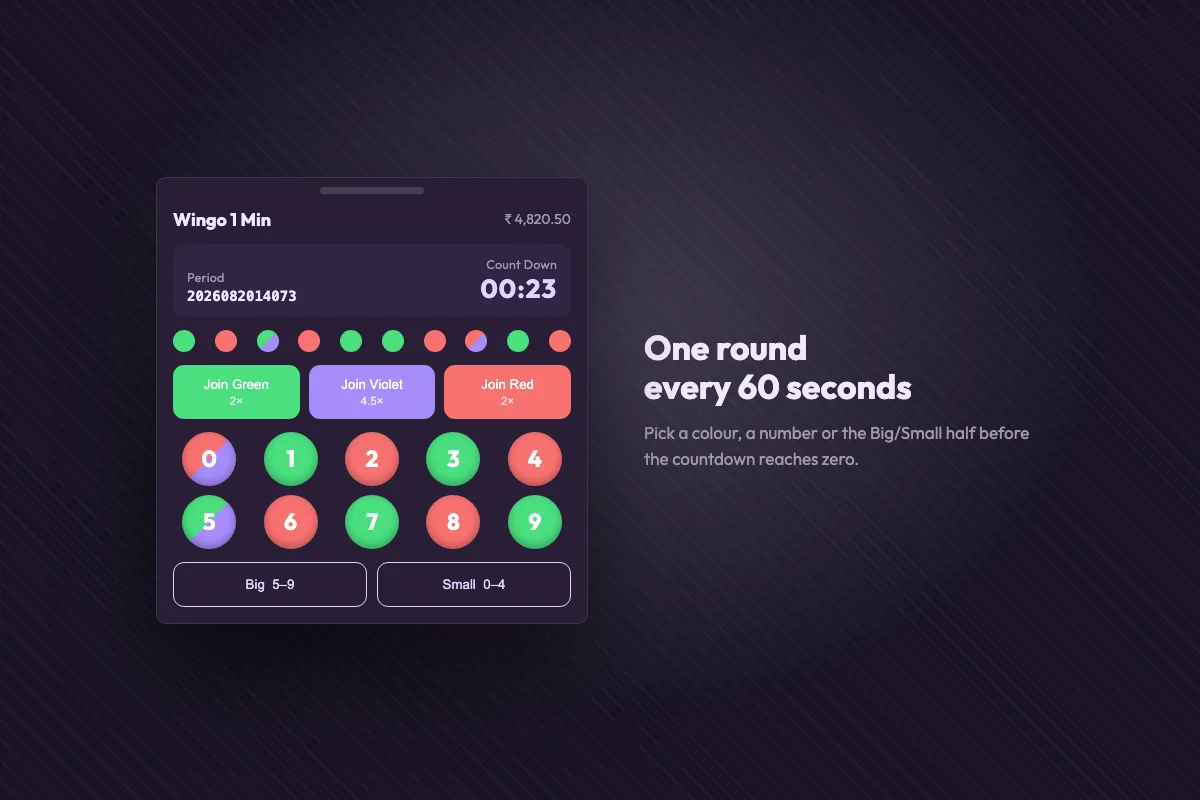
Colour prediction round board with a sixty second countdown, green, violet and red bet buttons and number balls zero to nine

This website is for informational purposes only and is not a gambling operator: we do not accept bets or payments. 18+. Gambling involves risk and may lead to addiction — please gamble responsibly. Information (bonuses/terms/licenses) may change: check current rules on the operator’s website. We are not responsible for decisions and financial losses related to the use of third-party services.